30-Days Money Back Guarantee

Delivery in 2-5 business days

Proud member

5.0 Stars on Google Reviews
30-Days Money Back Guarantee
Delivery in 2-5 business days
Proud member
5.0 Stars on Google Reviews
Delivery in 2-5 business
5.0 Stars on Google Reviews Warranty on All Containers
Understanding container weight terminology is key to safe and efficient shipping. Terms like tare weight, gross weight, and payload capacity tell you exactly how much a container weighs on its own, how much it can safely carry, and the total allowable weight during transport. Knowing these numbers isn’t just helpful, it’s essential for proper loading, avoiding fines, and staying compliant with global shipping regulations.
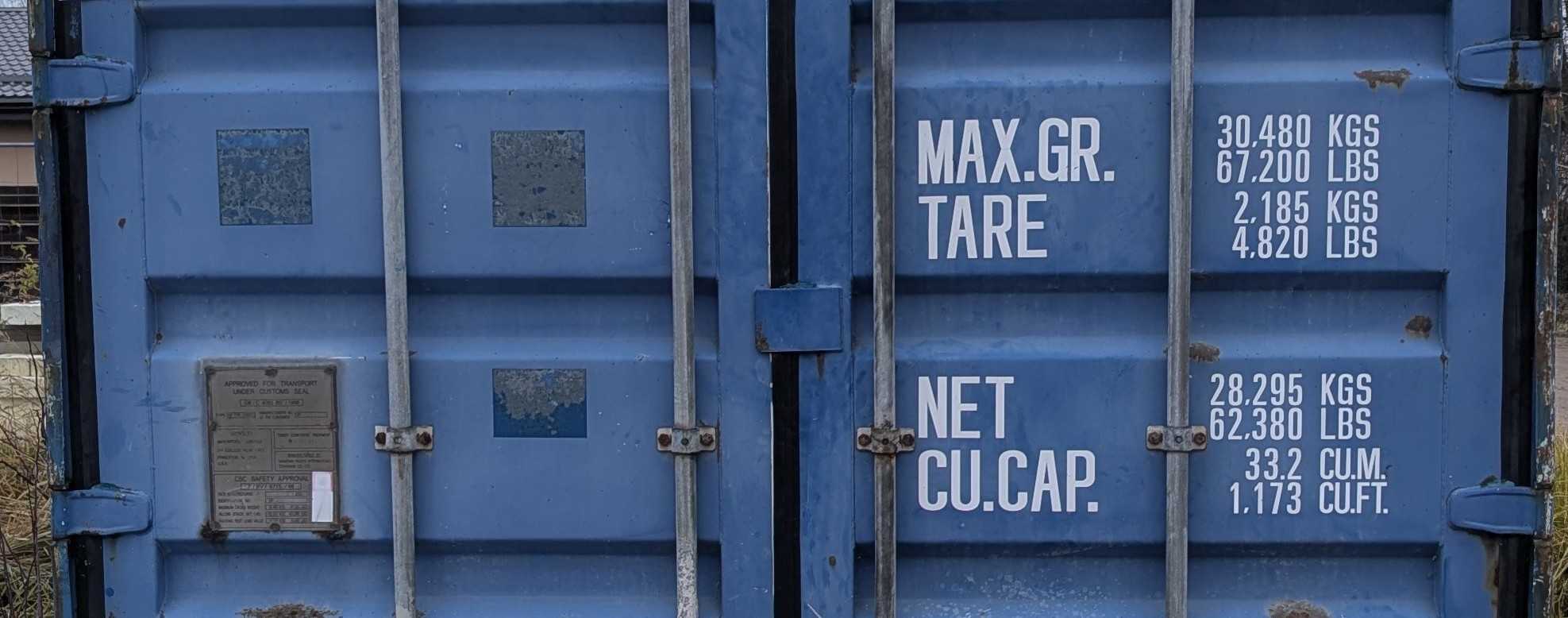
Gross weight refers to the maximum allowable weight of a loaded container, including both the container itself and all cargo inside. This number is extremely important in global shipping, especially due to safety requirements such as:
Shippers must verify container gross weight before loading to avoid tipping accidents, stack collapse, or vessel imbalance. Gross weight is stamped on the container's CSC plate and must be accurately declared.
Tare weight is the weight of an empty shipping container with no cargo inside. It reflects only the container's structure, typically made of corten steel, marine-grade flooring, and hardware like corner castings and doors.
Tare weight is measured at manufacturing facilities using certified industrial scales. Every container also has its tare weight listed on the CSC plate on the doors.
Payload capacity refers to the maximum weight of cargo a container can safely carry. It does not include the weight of the container itself.
It’s calculated using:
Payload = Gross Weight – Tare Weight
Payload is limited not only by structural strength but also by:
Exceeding payload limits can result in fines, shipping delays, or rejected cargo.
Cubic capacity is the total internal volume of a shipping container, measured in:
It tells you how much 3-dimensional space is available for your cargo inside the container.
Accurate shipping container weight data helps avoid safety hazards, compliance issues, and expensive operational disruptions. Below are key situations where knowing container weight is essential:
Shipping lines, freight companies, and terminal operators depend on precise weight measurements (tare, gross, and payload) to coordinate loading sequences, container stacking, and vessel stability. Weight discrepancies can trigger shipment rejections or cause significant delays at loading facilities.
Truck drivers must verify that the total weight complies with road weight regulations and axle load limits. Containers exceeding legal limits can incur penalties, require alternative routing, or be refused by ports and distribution centers.
All material handling equipment operates within specific capacity limits. Whether deploying gantry cranes, container handlers, forklifts, or reach stackers, accurate weight information is vital for protecting personnel and preventing equipment failure during cargo operations.
When deploying containers for construction purposes, residential conversions, temporary retail spaces, or office units, the supporting surface or foundation must withstand the container's total weight.
Installing insulation systems, interior framing, utilities, climate control, or structural reinforcements adds substantial weight. Accurate weight calculations ensure that transport machinery and support structures can accommodate these modifications safely.
Under the Safety of Life at Sea (SOLAS) convention, shippers must provide a Verified Gross Mass (VGM) before containers can be loaded aboard vessels. This mandatory requirement prevents dangerous conditions including vessel instability, container tipping, and stack failures at sea.
Each container size has a different tare weight (the weight when empty), which directly impacts how much you can load and which equipment can safely move it.
Container Size | Tare Weight (Empty) | Typical Payload Capacity | Internal Cubic Capacity |
|---|---|---|---|
10 ft Standard | 2,600–3,300 lb (1,200–1,500 kg) | ~19,800 lb (8,900 kg) | ~563 ft³ (~16 m³) |
20 ft Standard | 4,400–5,100 lb (2,000–2,300 kg) | ~55,000 lb (25,000 kg) | ~1,172 ft³ (~33.2 m³) |
20 ft High Cube | 5,300–5,700 lb (2,400–2,600 kg) | ~ 62,000 lb (28,100–28,200 kg) | ~ 1,314–1,320 ft³ (~ 37.3–38 m³) |
40 ft Standard | 7,800–8,800 lb (3,600–4,000 kg) | ~58,000 lb (26,300 kg) | ~2,389 ft³ (~67.7 m³) |
40 ft High Cube | 8,800–9,300 lb (3,900–4,200 kg) | ~57,000 lb (25,800 kg) | ~2,700 ft³ (~76 m³) |
45 ft High Cube | 10,500–11,000 lb (4,800–5,000 kg) | ~59,000 lb (26,700 kg) | ~3,036 ft³ (~86 m³) (typical) |
A 10-foot shipping container weighs approximately 2,600–3,300 pounds (1,200–1,500 kg) when empty (tare weight). It has a typical payload capacity of around 19,800 pounds (8,900 kg) and offers an internal volume of about 563 cubic feet (16 m³).
Used 10ft containers may weigh slightly more or less depending on previous repairs, flooring replacements, or added features like insulation.
Although it's not commonly used in international shipping, the 10ft container is ideal for compact storage needs, construction sites, pop-up businesses, and mobile offices. Despite its smaller footprint, it’s built to the same standards as larger containers, using corten steel construction and marine-grade plywood flooring, making it durable and weather-resistant. Its lighter weight also means lower transport costs and easier handling, especially in urban or space-limited environments.
A new standard 20-foot shipping container weighs between 4,400 and 5,100 pounds (2,000–2,300 kg) when empty. It supports a payload capacity of up to 55,000 pounds (25,000 kg) and offers around 1,172 cubic feet (33.2 m³) of internal space.
A used 20ft container may have minor weight fluctuations based on rust buildup, previous modifications, or structural reinforcements.
20ft is the most commonly used container size in global logistics, valued for its balance of capacity, durability, and maneuverability. It's frequently used for international freight, construction storage, retail inventory, and container conversions like small offices or mobile kiosks. A 20ft container is designed for stacking, freight compatibility, and easy transportation with standard handling equipment.
A new 20-foot high cube container weighs approximately 5,300–5,700 pounds (2,400–2,600 kg) when empty. It can typically carry up to 62,000 pounds (28,100–28,200 kg) of payload and offers 1,314–1,320 cubic feet (37.3–38 m³) of internal volume.
The extra 12 inches in height compared to a standard 20ft container provides greater vertical clearance, making it suitable for taller cargo, stacked goods, or interior conversions where height matters. This size is less common but highly practical for specialized logistics, event builds, or modular structures requiring additional headroom without increasing the container’s footprint.
A new 40-foot standard shipping container weighs between 7,800 and 8,800 pounds (3,600–4,000 kg) when empty. Its payload capacity is around 58,000 pounds (26,300 kg), with an internal cubic capacity of approximately 2,389 ft³ (67.7 m³).
Used 40ft containers may weigh more if they’ve been repaired with heavier steel patches or retrofitted for alternate uses.
As a widely used option in global trade, the 40ft container doubles the internal space of a 20ft unit without doubling the tare weight, offering excellent space-to-weight efficiency. It’s commonly found in freight forwarding, construction storage, and large-scale container modifications like homes, showrooms, and mobile clinics.
A 40-foot high cube shipping container has a tare weight of about 8,800–9,300 pounds (3,900–4,200 kg). It carries a typical payload of 57,000 pounds (25,800 kg) and offers an internal volume of approximately 2,700 cubic feet (76 m³).
The additional foot in height compared to the standard 40ft model increases both its capacity and overall weight, but it remains compatible with the same transport and storage systems. It’s ideal for applications where vertical space is crucial—such as warehouse overflow, container living, or trade show displays. The extra internal height allows for more flexible stacking or interior build-outs in modular construction projects.
A 45-foot high cube container weighs between 10,500 and 11,000 pounds (4,800–5,000 kg) when empty. It supports a payload of approximately 59,000 pounds (26,700 kg) and provides about 3,036 cubic feet (86 m³) of usable internal space.
As one of the largest ISO-standard container sizes, the 45ft high cube offers maximum volume and is built with reinforced corner posts, strengthened bases, and extended side rails to maintain structural integrity over its longer span. It’s commonly chosen for oversized cargo, tall or bulky goods, and custom modification projects like tiny homes, portable studios, or retail environments where every extra inch of space enhances usability. While heavier and longer, it’s still designed to work with standard intermodal transport systems.
Shipping container weights vary based on several factors, including age, type, and modifications. Understanding these variables is essential for safe transport, accurate payload calculations, and cost-efficient handling.
A container’s age and condition can slightly affect its tare weight. Older containers may weigh more or less than their original specifications due to maintenance, wear, and repairs. Common factors include:
New containers generally have consistent tare weights, but used containers may vary by a few percentage points. For logistics planning, it’s important to check the exact weight listed on the CSC plate rather than relying solely on standard specifications.
The type of container significantly influences its weight because of structural differences and materials used:
Choosing the right type of container not only affects transport costs but also determines the maximum payload that can be safely carried.
Containers are often modified for residential, commercial, or specialized storage purposes. Modifications can increase or decrease the weight significantly:
After any modification, it’s crucial to recalculate payload capacity and ensure lifting and transport equipment can safely handle the updated weight. Failing to do so can lead to structural stress, transport violations, or safety hazards.
When transporting containers, understanding regulatory and safety requirements is just as important as knowing the container’s weight. Compliance ensures not only legal transport but also the safety of personnel, cargo, and infrastructure.
The Verified Gross Mass (VGM) is the certified total weight of a fully loaded container, including the container itself, cargo, and all packaging. Under the SOLAS (Safety of Life at Sea) regulations, shippers are legally required to provide the VGM before a container is loaded onto a vessel.
Shippers can determine VGM using one of two methods:
Ensuring the VGM is correct protects against stack collapses, tipping accidents, and other hazards associated with improperly loaded containers.
Each mode of transport enforces strict weight limits to prevent accidents, structural damage, and legal violations:
By knowing container weights and adhering to regulatory requirements, shippers can ensure safe, compliant, and cost-efficient logistics, reducing the risk of accidents, fines, and costly delays.
At Viva Containers, we supply high-quality shipping containers that meet global ISO standards for safety and performance. We offer both new shipping containers and used container units, including specialized options like high cubes, open-side, and double-door units to fit your specific needs.
Verified quality: Every container is thoroughly inspected, graded, and photographed to ensure structural integrity, from reinforced corner castings to intact door seals and certified CSC plates.
Transparent process: Our team guides you in selecting the right container for shipping, storage, or conversion, then plans transport and verifies site access to ensure smooth delivery.
Viva Containers delivers consistent quality, verified condition reports, and reliable service making us a dependable supplier for first-time buyers and experienced operators alike.